A customer engagement platform is software that unifies customer data, interaction channels, automation, and analytics to coordinate every interaction a company has with customers across the lifecycle. You’re probably asking because your stack already has a CRM, a chat widget, and an automation tool, yet a high-intent visitor still waits hours for a reply. That gap between knowing about a customer and acting in the moment is exactly what this category was built to close.
Table of Contents
- What Is a Customer Engagement Platform
- How Customer Engagement Platforms Work
- Key Features of a Customer Engagement Platform
- Customer Engagement Platform vs CRM vs Marketing Automation
- Business Benefits and Real-World Use Cases
- How to Choose the Right Customer Engagement Platform
- The Bottom Line on Customer Engagement Platforms
What Is a Customer Engagement Platform
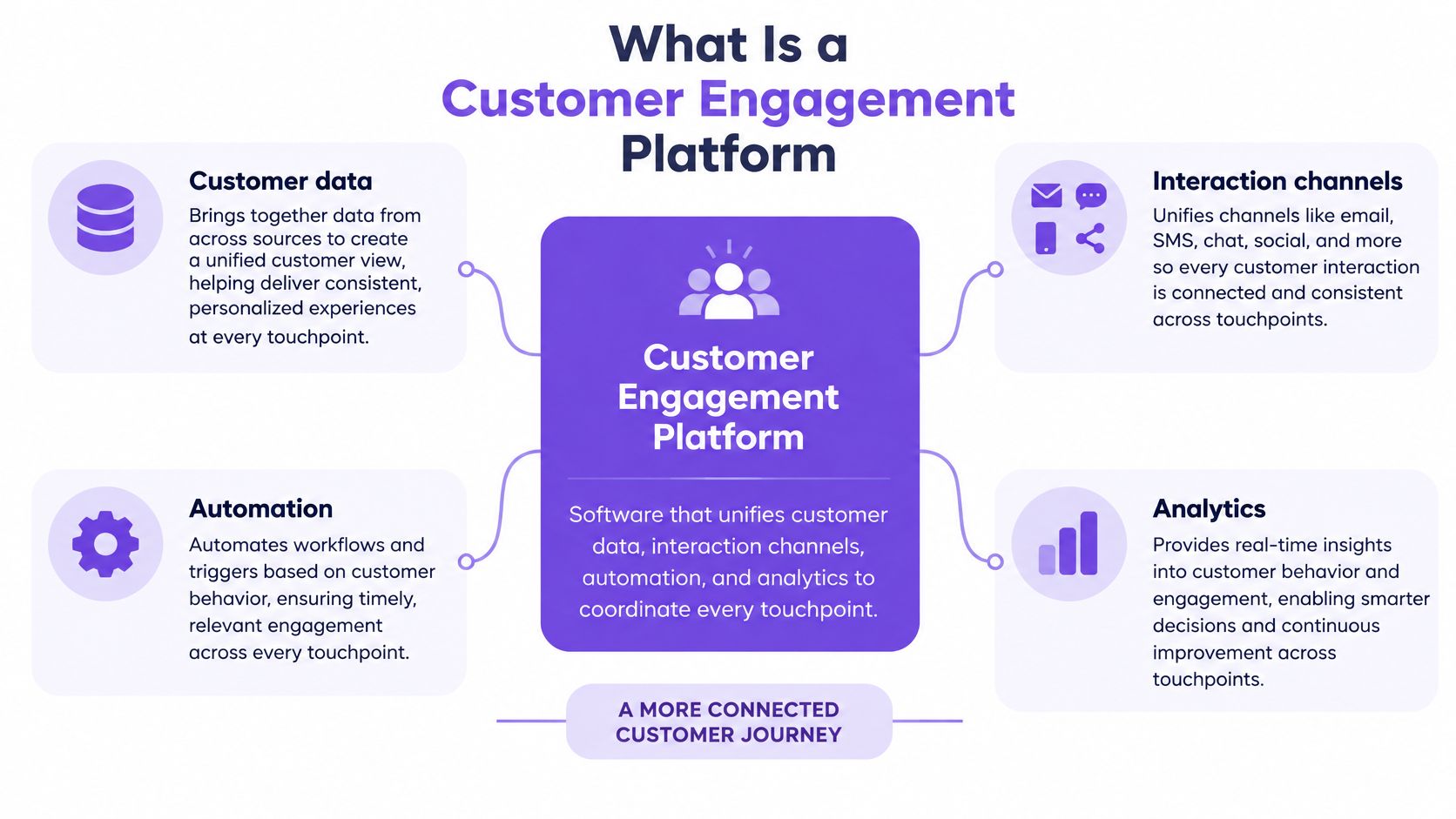
If a colleague asks what is a customer engagement platform, use this sentence. It’s software that unifies customer data, interaction channels, automation, and analytics to coordinate every touchpoint across marketing, sales, service, and digital channels. The key word is coordinate, not store or send.
The component map below shows those four parts as one connected system rather than four separate tools.
What It Isn’t
It isn’t a chatbot. A chatbot answers inside one widget. An engagement platform decides whether that visitor should get AI help, a live rep, a meeting link, or nothing yet, then records what happened.
It also isn’t just an omnichannel inbox. An inbox collects messages from email, chat, and social in one queue. That’s useful, but it starts after the customer reaches out, while an engagement platform also watches behavior and initiates action.
Think of a conductor rather than an instrument. The conductor doesn’t play the violin. The conductor knows the score, cues each section at the right moment, and keeps everyone in the same tempo. Your CRM, chat, video, and calendar are the instruments.
Where the Category Came From
The foundation is CRM. Before 1993, the market was largely split between sales force automation and customer service systems, and by the late 1990s those functions were consolidating into integrated platforms, as traced in the history of CRM consolidation through the 1990s. CRM was added to Bain’s management tools survey in 2000, ranking 15th and reportedly used by 35% of respondents.
CRM solved centralization. It didn’t solve timing. Engagement platforms extend that record keeping into real-time orchestration, where a signal in one channel triggers a human or automated response in another. Teams exploring how that plays out in service contexts often start with guides to AI-powered customer interactions, which cover the support side of the same orchestration idea.
That continuity is the whole point. A pricing page visit, a chat question, and a booked demo stop being three disconnected events. They become one workflow your teams can see and measure.
How Customer Engagement Platforms Work
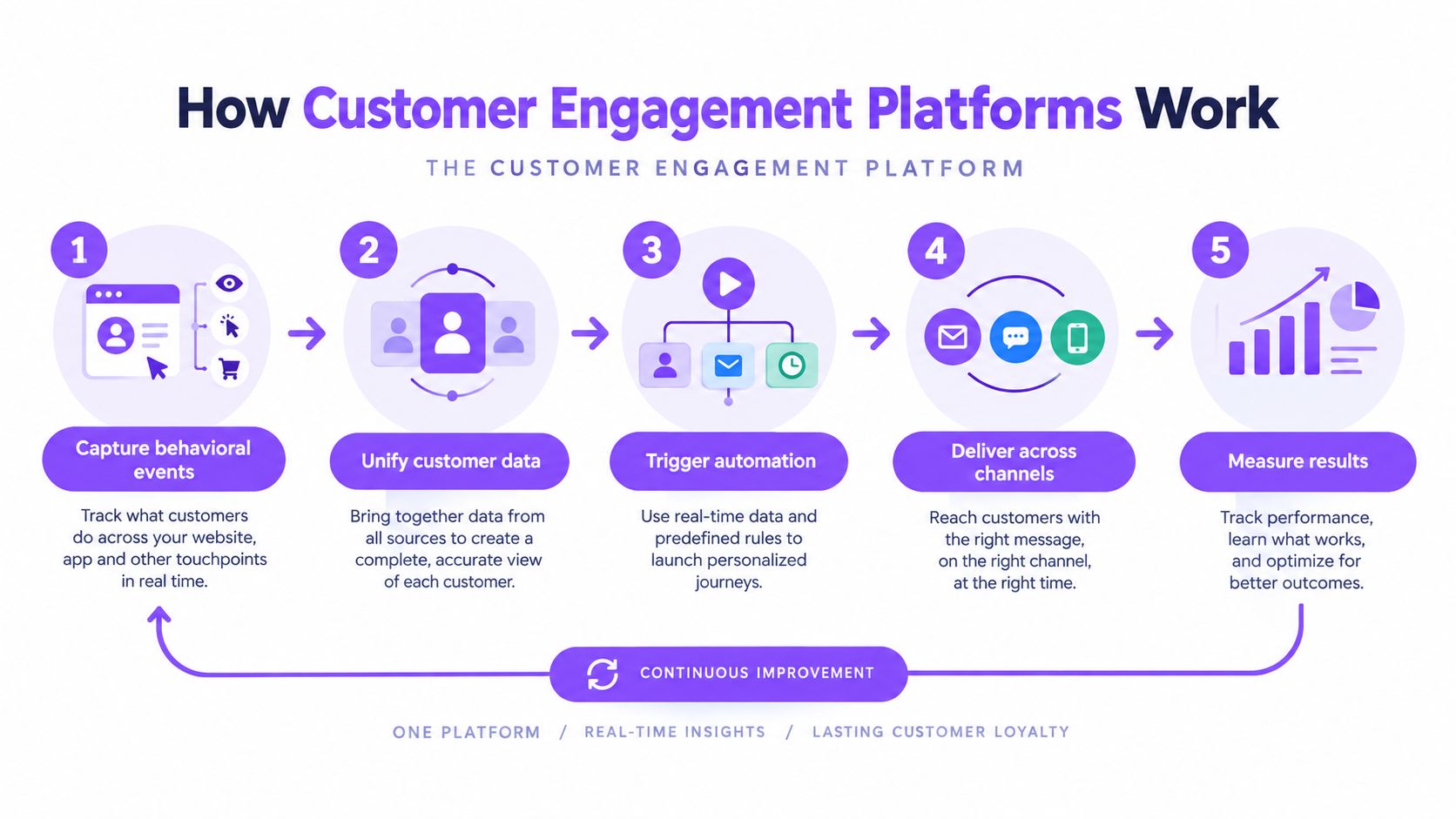
Picture air traffic control. Controllers don’t fly planes. They watch signals, identify each aircraft, judge priority, assign a runway, and log the outcome so the next controller has full context. An engagement platform runs the same loop for visitors.
The flow below maps that loop from first signal to measured outcome.
The Five Stage Loop
- Capture the event: A visitor hits your pricing page for the second time this week, or opens chat at 9 p.m. The platform records the behavior with time and context.
- Resolve identity: It matches the visitor to a known contact or account where possible, using deterministic signals first. Anonymous traffic gets a company level profile rather than a guessed name.
- Score intent: Rules and AI weigh the signals. Repeat pricing visits plus a target account match scores higher than a single blog read.
- Trigger the action: High intent routes to a rep for live video. Lower intent might get AI chat or a scheduling prompt. No signal, no interruption.
- Write back the outcome: The conversation, meeting, or non-response syncs to the CRM. That feedback sharpens the next round of scoring.
Practical rule: If step five doesn’t happen automatically, you don’t have an engagement platform. You have another silo your reps must update by hand.
The Architecture Underneath
Four layers make the loop possible. Cloud infrastructure and APIs connect the CRM and adjacent systems. A centralized data layer holds profiles, interaction history, and transactions. An AI and machine learning layer handles segmentation, prediction, and next best action decisions. An automation engine executes event triggered workflows, per the layered technical architecture described for CEP systems.
Deployment can look deceptively light. Capturing website events may take a single JavaScript snippet. The work is turning raw events into governed profiles and measurable sales workflows, a discipline service businesses apply too when they improve cleaning lead follow-up with Estimatty by tightening the path from first inquiry to booked job.
This short walkthrough shows the loop running end to end on a live site.
Key Features of a Customer Engagement Platform
Don’t evaluate features as spec sheet lines. Evaluate them as jobs. Each capability below exists because a revenue team kept losing the same moment.
Features That Create Conversations
- Live in-browser video: A rep meets a high-intent visitor face to face without downloads or calendar tennis. The job is collapsing days of follow-up into one immediate conversation.
- AI chat: It qualifies visitors, answers routine questions, and covers nights and weekends. Scheduling capable tools such as AI chat that books appointments show the pattern on the booking side, where the AI’s job ends at a confirmed meeting, not just a friendly reply.
- Visitor identification and intent detection: The platform de-anonymizes traffic at the company level and flags buying signals. Your team stops treating every visitor as equally unknown.
- Routing rules: Territory, account ownership, language, and availability decide who gets pinged. The right visitor reaches the right rep while intent is still warm.
Channel choice isn’t a nice extra. In a 2025 global study of nearly 24,000 consumers in 23 countries, 61% preferred a human mediated channel across nine common interactions, while only 8% preferred automated chat on average, according to the 2025 Qualtrics global channel preference study. Automation that blocks the path to a person works against what customers want.
Features That Remove Friction
One-click scheduling with calendar sync replaces the form, the wait, and the three follow-up emails. Co-browsing lets a rep guide a prospect through your product or pricing page in the same browser tab, which kills the “can you see my screen” detour entirely.
Native CRM sync is the feature buyers underrate until they live without it. Conversations, meetings, intent signals, and identified accounts land in HubSpot or Salesforce automatically. This is also where engagement meets strategy, since the tactics behind what conversational marketing means in practice only work when every conversation feeds the record your pipeline reporting depends on.
Governance as a Feature
Security controls belong on the same checklist as video and chat. Look for SOC 2 and ISO 27001 certification, plus GDPR and CCPA controls covering consent, retention, and deletion. If a vendor treats governance as an enterprise add-on, that’s a signal about how the product was built.
Customer Engagement Platform vs CRM vs Marketing Automation
Most confusion around this keyword isn’t about the new tool. It’s about the tools you already own. Each category has one core job, and the trouble starts when you ask one to do another’s job.
The Core Job of Each Category
A CRM is your system of record. It holds contacts, accounts, deals, and history. Ask it what you know about a customer and it answers well. Ask it to react to a live pricing page visit in the next ten seconds and it can’t, because it was never built for that.
Marketing automation runs scheduled, batch campaigns to segments. It’s strong at nurture sequences and campaign reporting. It’s weak at the individual, in-the-moment decision, because batch logic runs on lists, not live behavior.
Conversational AI isn’t a platform at all. It’s a component technology that handles dialogue. It can live inside an engagement platform, a support tool, or a standalone widget, but on its own it doesn’t resolve identity, route reps, or sync outcomes.
An engagement platform is the system of action sitting between them. It reads the CRM record, watches live signals, orchestrates human and automated responses together, and writes outcomes back. It doesn’t replace the record. It makes the record move.
Side by Side Comparison
| Category | Primary Job | How It Engages | Where It Falls Short |
|---|---|---|---|
| CRM | Store customer truth | Passive records and pipelines | No real-time reaction to live signals |
| Marketing automation | Run campaigns at scale | Scheduled batch sends to segments | Slow, list based, weak at one-to-one moments |
| Conversational AI | Hold automated dialogue | Chat and voice responses | No identity, routing, or outcome sync alone |
| Customer engagement platform | Orchestrate action in real time | Event triggered AI, video, chat, scheduling | Depends on CRM data quality to decide well |
The simplest test is the question you’re asking. “What do we know about this account” is a CRM question. “What should happen next, right now” is an engagement platform question.
Practically, most B2B teams keep the CRM, keep a leaner automation setup, and add the engagement layer for live moments. Consolidation candidates are usually the point tools the platform absorbs, such as standalone chat widgets and separate scheduling links. Budget conversations get easier once you frame it that way, because you’re not ripping out your system of record. You’re adding the layer that finally uses it in real time.
Business Benefits and Real-World Use Cases
Benefits decks love abstract ROI claims. The wins are smaller and more concrete. They look like specific moments your team either catches or misses.
Four Moments That Matter
A head of operations from a target account lands on your pricing page Tuesday at 11 a.m. Without an engagement platform, she fills a form and waits, or doesn’t fill it at all. With one, intent scoring flags the visit, routing pings the account owner, and she’s in a live video conversation while her questions are still fresh.
A founder researches your product Saturday night. Nobody’s online, and in most stacks that visit evaporates. Always-on AI chat qualifies him, answers the basics, and books a Monday call with the right rep. Your pipeline stops leaking outside business hours.
Your ABM list has fifty priority accounts, but your site traffic is anonymous. Visitor identification reveals which target companies are browsing and which pages they’re reading. SDRs prioritize accounts showing live intent instead of working a static list in alphabetical order.
A prospect books a demo, then life happens. One-click scheduling with automated reminders and easy rescheduling cuts the no-show risk that comes from friction and silence. The same continuity helps after the sale, which is why engagement data feeds naturally into how customer success operations teams coordinate accounts across renewals and expansion.
The Automation Tension
There’s a gap buyers should sit with. 78% of consumers say switching from an AI agent to a human is important, while 83% of business leaders believe conversational AI can replace human agents, according to Twilio’s report on conversational AI adoption.
Both instincts point at the same answer. The benefit isn’t automation instead of people. It’s a hybrid model where AI provides coverage and speed, and humans take over the moment complexity or buying intent shows up. Platforms sold purely on containment tend to disappoint. Platforms designed around the handoff tend to compound.
How to Choose the Right Customer Engagement Platform
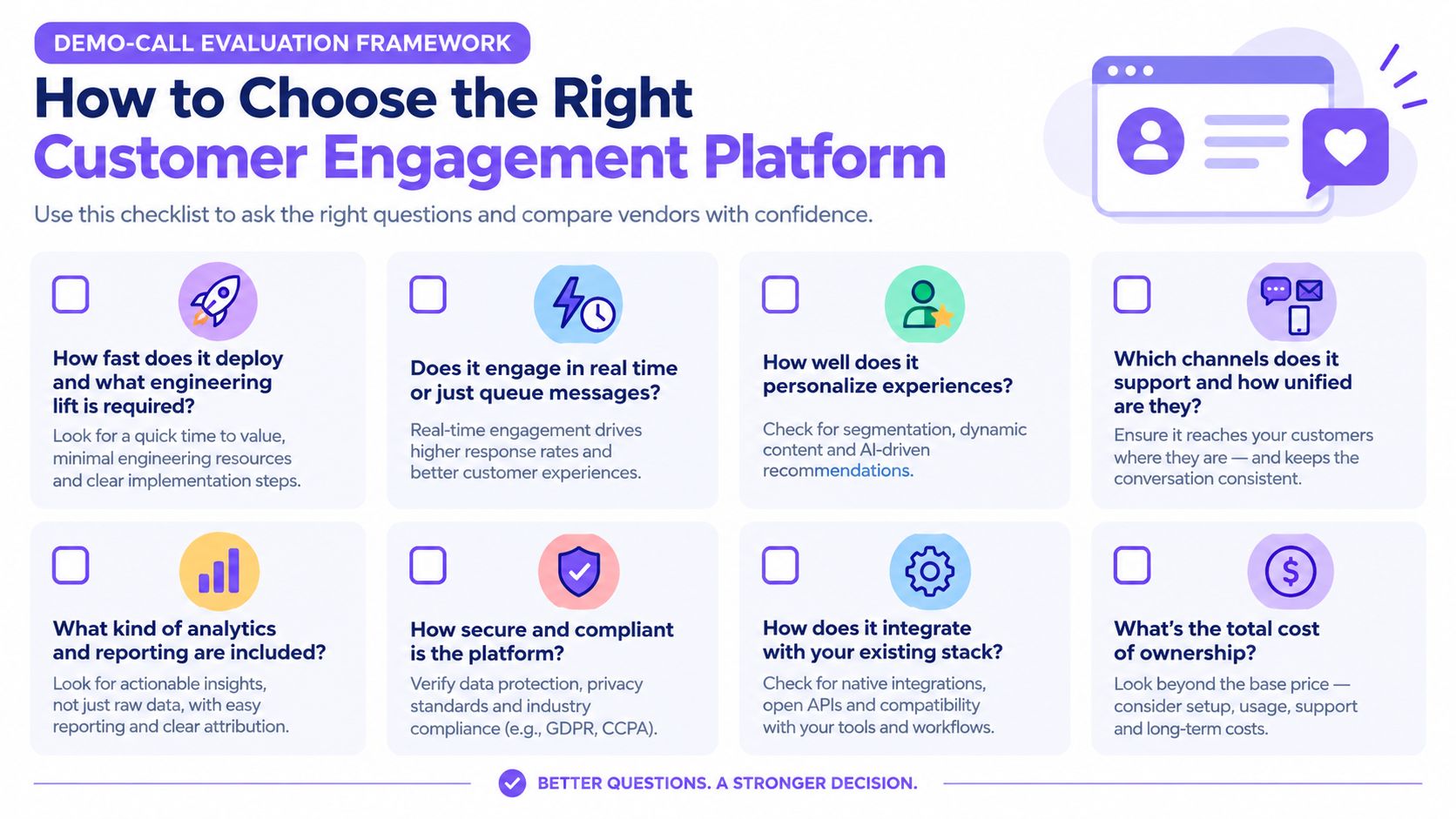
Demos all look polished. Separate vendors by asking questions with verifiable answers. Bring these six to every call.
The checklist below turns those questions into a scorecard you can reuse across vendors.
Six Questions for Every Demo
- How fast does it deploy: A single snippet with same day go-live is a different risk profile than a multi-week engineering project. Ask what your team must build versus configure.
- Does it engage in real time: Queuing a follow-up email isn’t engagement. Ask to see a live trigger fire during the demo, not a screenshot of one.
- How does the human handoff work: When AI escalates, does the rep see the full transcript, visitor history, and intent signals. Does the customer have to repeat anything.
- Where do identity and intent signals come from: Signals you can’t explain are signals you can’t defend. Ask how errors get corrected and how confidence is shown.
- How deep is the CRM sync: Shallow sync creates duplicate records and manual cleanup. Deep sync, the kind covered in this guide to Salesforce integrations for sales teams, writes conversations, meetings, and intent to the right objects automatically.
- What do consent and audit controls look like: Ask how withdrawal, deletion, and correction requests propagate to connected systems, since the operational mechanics of consent under GDPR and CCPA require enforcement across destinations, not just inside one tool.
Why Privacy Belongs in the Evaluation
Personalization has a trust cost. 61% of consumers said they don’t believe brands use their data in their best interest, 84% wanted control over personalization settings, and 54% wanted to know when they were speaking with AI, per Twilio’s State of Customer Engagement findings. Treat data minimization, AI disclosure, and explainable targeting as selection criteria, not legal afterthoughts.
Captiwate is one worked example of the B2B shape of this category. It combines in-browser video with AI chat, intent detection, HubSpot and Salesforce sync, and single snippet deployment. Its pricing is traffic based with unlimited seats and conversations, and it carries SOC 2 Type II and ISO 27001 certification. Use it as a reference point for the questions above, then judge every vendor, including it, on the answers.
The Bottom Line on Customer Engagement Platforms
Compress everything into three ideas you can carry into a buying conversation.
First, a customer engagement platform is an orchestration layer. It turns scattered signals, a page visit here, a chat there, a booking somewhere else, into coordinated action with a measurable outcome. If a tool can’t connect observation, decision, engagement, and write-back, it’s a point tool wearing platform clothing.
Second, it complements your CRM rather than replacing it. The CRM stays the system of record. The engagement platform becomes the system of action that reads that record and reacts while the customer is still present. Teams that expect one tool to do both jobs usually end up disappointed in both.
Third, the differentiator that matters most is the AI to human handoff. AI coverage wins you speed and availability. A clean escalation path, with full context and honest disclosure, wins you trust and closed deals. Judge platforms on that seam, because that’s where customers feel the difference.
Do this week: Time how long a high-intent visitor on your own pricing page waits for a real human response today. That single number tells you whether you have an engagement problem worth solving.
If that audit shows hours where seconds are now possible, you don’t have a traffic problem. You have a coordination problem. That’s precisely the problem this category exists to fix, and it’s a fix your buyers will notice before your dashboards do.
If your pricing page audit shows high-intent visitors waiting hours for a response, Captiwate connects them to your reps by in-browser video or AI chat in the moment, with every conversation and meeting synced to your CRM. Visit the site to see a live engagement trigger fire and judge the handoff quality for yourself.