Most advice about hiring a B2B influencer agency starts with the wrong question: How many people can this creator reach? Reach is easy to put in a deck. It’s much harder to show whether the right accounts engaged, whether buying conversations followed, and whether opportunities moved.
That distinction matters because influencer marketing is no longer just a test budget. A September 2024 survey of 404 U.S. B2B marketing professionals at companies with at least 100 employees found 81% had a dedicated influencer-marketing budget, while 53% of U.S. B2B marketers reported a growing dedicated budget in 2024 (MarketingProfs’ B2B influencer marketing research). A funded program deserves more than a report of posts published and impressions earned.
The agency you want isn’t a content vendor with a creator list. It’s the function that connects expert credibility to account-level pipeline, and makes the connection measurable.
Table of Contents
- The Uncomfortable Truth About B2B Influencer Programs
- What a B2B Influencer Agency Actually Does Day to Day
- Core Services Every B2B Influencer Agency Should Offer
- How B2B Influencer Agencies Price Their Work
- When an Agency Beats In-House vs the Hybrid Model
- How to Evaluate and Shortlist B2B Influencer Agencies
- Measuring Influence as Pipeline, Not Vanity
The Uncomfortable Truth About B2B Influencer Programs
A polished campaign report can hide an unanswered commercial question: did any buyer move closer to a decision? B2B marketing teams that treat engagement as proof of revenue leave that question unresolved. In CMI’s 2025 B2B research, 56% of marketers said they struggle to attribute ROI to content, the same share struggled to track customer journeys, and 44% reported difficulty tying performance to business goals (Content Marketing Institute’s B2B content marketing research). Those findings concern content marketing broadly; they illustrate the measurement challenge without establishing how many influencer programs face it.
A LinkedIn post can attract thoughtful comments while leaving sales with no visible evidence of buyer interest. The post may still contribute value. But a reach report cannot establish whether relevant buyers saw it, considered the argument, or used it in a purchasing conversation.
Distribution is only the beginning of the evidence
B2B purchases involve multiple stakeholders and repeated interactions. A practitioner introduces an idea. An executive shares a point of view, and a sales conversation follows later through another channel. Last-click attribution compresses that journey into its final touch; impressions establish exposure without explaining what followed.
Require an agency to account for that uncertainty.
Its measurement approach should connect creator activity to identifiable target-account engagement and opportunity signals, while distinguishing observed influence from claimed causation. A 2024 benchmark reported that 93% of B2B brands measured awareness, 88% tracked engagement, and 44% tracked conversions (B2B influencer marketing benchmarks). Ask what evidence sits behind each reported outcome and where the agency’s visibility ends. Conversion tracking alone does not establish that a creator caused a sale.
The buying test: An agency that cannot connect its work to accounts, CRM records, and opportunity progression is selling activity rather than accountability.
Expert credibility also deserves a separate judgment from audience size. Sift AI’s key opinion leader marketing guide offers useful context for that distinction. Evaluate trusted voices by the buying questions they can help resolve. Then require the agency to explain how it will recognize buyer progress, including the limits of what its reporting can prove.
What a B2B Influencer Agency Actually Does Day to Day
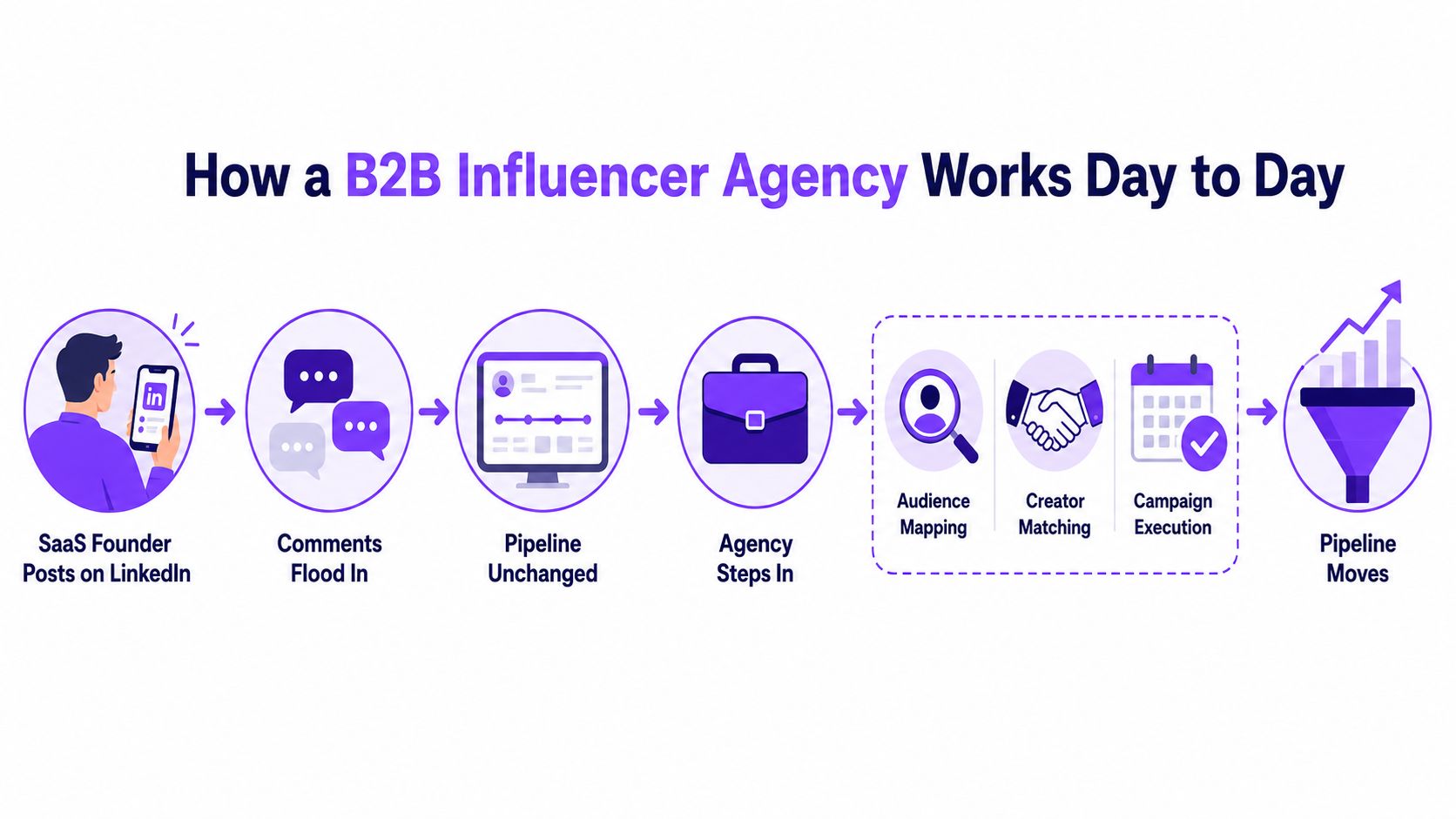
A Series B SaaS founder starts posting on LinkedIn. The comments are lively, a few industry figures join the conversation, and the team shares screenshots internally. But sales can’t tell whether target accounts participated, and the pipeline report looks unchanged. The company has activity. It doesn’t yet have an operating program.
The agency’s work starts behind the post. First, it clarifies which customer profiles and accounts matter, what buyers need to understand, and what commercial action the campaign should support. Then it checks whether prospective creators have relevant expertise and whether their audiences overlap with the people involved in those buying decisions.
From audience fit to a workable campaign
Suppose the company sells workflow software to operations leaders. A creator with a large general business audience might look attractive on paper, but a practitioner who regularly discusses operations problems may be more useful. The agency should examine subject-matter authority, the relevance of the audience, and the quality of professional engagement, not just the follower count.
After matching, the agency turns strategy into a usable brief. It might invite a creator to explain a genuine workflow challenge, join a webinar, or contribute to a discussion that gives buyers something useful before any product pitch. The company reviews claims for accuracy and disclosure, while the creator retains room to speak naturally. A campaign that reads like corporate copy spends credibility rather than earning it.
Execution includes scheduling, approvals, content coordination, and distribution. A good agency also prepares the handoff: trackable links and campaign identifiers connect visits and interactions to CRM records, so sales and marketing can see which accounts engaged and what happened next. The agency should make clear who owns creator relationships, who controls the data, and who follows up on high-intent activity.
What the proposal should make visible
When you review a proposal, look for named activities, owners, and outputs across the full workflow. If it lists creator posts but says little about audience fit, approvals, distribution, or CRM handoff, ask what’s missing and who will do that work. A client shouldn’t have to guess whether a critical step is included.
The practical definition is simple: a B2B influencer agency finds and coordinates credible industry voices, then connects their work to the company’s marketing and sales process. The post is one deliverable. The operating system around it is what you’re hiring.
Core Services Every B2B Influencer Agency Should Offer
Hire an agency to connect creator credibility to account-level pipeline. Its service offer should make that connection testable: who qualifies the audience, who protects credibility, and who proves commercial progress. A roster and a reach report leave too much work with your team.
Strategy and ICP mapping
Require a written selection framework covering your ideal customer profile, target accounts, buying roles, and evaluation topics. A cybersecurity vendor selling to IT leaders needs evidence that security practitioners reach those buyers. “Technology audience” is too broad to approve.
The deliverable should explain how the agency checks relevance and rejects weak matches.
Ask: How will you verify that a creator’s audience overlaps with our buyers and named accounts?
Creator selection and relationship management
Require a creator scorecard covering expertise, audience fit, engagement quality, reliability, commercial suitability, and disclosure risk. Ask for evidence of subject knowledge and substantive buyer conversations. Follower count alone cannot establish account overlap.
Use B2B influencer marketing benchmarks as background context; make selection decisions using evidence about each creator’s relevance to your buyers.
Relationship management also needs a record of commitments, communication, and performance that survives a change of agency.
Ask: Who owns the creator relationships, and will we retain access to the creator information and performance history?
Campaign execution and content governance
Expect briefs, timelines, reviews, publishing, and follow-up to have named owners. Require an approval process for technical claims, paid-relationship disclosures, and corrections, with clear escalation when a creator misses a commitment.
Protect the creator’s voice through specific review boundaries. Your technical team should check accuracy; brand review should avoid rewriting every contribution into corporate copy. Ask to see an approval example before signing.
Measurement and CRM integration
Require reporting that connects creator and content identifiers to interactions, target accounts, contacts, and opportunities. The agency should document CRM fields, data handoffs, and the limits of attribution. An account engaging with content is evidence of engagement, not proof that the creator caused a deal.
A guide to creator campaign management helps frame campaign responsibilities. Request the agency’s actual reporting template and inspect whether it separates delivery metrics from influenced pipeline.
The buying question: Can the agency show what it owns from initial audience research through CRM reporting, and where your team must step in?
How B2B Influencer Agencies Price Their Work
Pricing often conceals scope. Two proposals can use the same label, such as “monthly retainer,” while covering very different work. Ask for a breakdown of strategy, creator compensation, production, campaign operations, paid amplification, measurement, and any technology fees before comparing totals.
| Pricing Model | Typical Range | What’s Included | Watch Out For |
|---|---|---|---|
| Monthly retainer | Not stated in verified data | Ongoing planning, creator coordination, campaign management, and reporting, depending on scope | Vague deliverables, unclear creator fees, or no named measurement work |
| Project or campaign fee | Not stated in verified data | A defined campaign, such as a creator collaboration, event, webinar, or content series | A one-off activation with no audience strategy or follow-up plan |
| Performance or hybrid | Not stated in verified data | A base fee plus an agreed outcome-based component, where outcomes are defined in advance | Paying for outcomes the agency can’t control or measure consistently |
No verified pricing ranges are available here, so don’t treat a dollar figure as a market benchmark. Instead, compare proposals by scope and accountability. A low fee may mean a small, focused engagement, or it may mean essential work is excluded. The proposal should specify whether creator compensation is included or passed through, what happens when a creator cancels, who pays for content reuse, and whether paid distribution costs sit outside the agency fee.
Price the work you need, not a headline number
A retainer can fit an ongoing program that needs continuous creator relationships, campaign operations, and reporting. A project fee may work when the brief is narrow and the business objective is defined. A hybrid model can align incentives, but only when the contract distinguishes what the agency controls from what depends on audience behavior, sales follow-up, and other factors.
Budget rule: Ask every agency to show the same scope in the same format. Compare the work, exclusions, and evidence you’ll receive, not the price label.
If a vendor promises a pipeline outcome, ask how it will be attributed, what counts as qualified, and how shared or indirect influence is handled. A performance fee doesn’t make measurement rigorous by itself. It makes the definition of success more important.
When an Agency Beats In-House vs the Hybrid Model
Choosing an agency isn’t a maturity badge. It’s a capacity decision. The right option depends on whether your team can identify credible creators, manage relationships, coordinate campaigns, and connect activity to the CRM without dropping work that matters more.
| Model | Best fit | Trade-off |
|---|---|---|
| In-house | A team with clear audience knowledge and time to manage a focused program | Direct control, but research and relationship work compete with other priorities |
| Agency | A team that needs specialist support across sourcing, execution, and measurement | More operating capacity, but the company must retain access to data and decisions |
| Hybrid | A team that wants internal ownership with outside help for specialist or time-intensive work | Keeps strategy close to the business, but responsibilities need clear boundaries |
A Series A team might keep the work in-house while validating whether credible practitioners engage the audience it wants. A Series B team scaling account-based programs may need agency support to build a repeatable creator process and connect it to account-level reporting. An enterprise team might own strategy and CRM governance internally while asking an agency to extend creator discovery, campaign delivery, or regional coverage.
Use account complexity as the deciding factor
A dedicated agency becomes more compelling when internal staff can’t reliably manage both creator relationships and the measurement demands of complex buying groups. But don’t outsource customer knowledge. Your sales team and account owners still need to shape the target account list, explain what buyers ask, and agree on how follow-up works.
That connection matters especially when influencer activity supports named-account selling. Align creator content with the account strategy, buying roles, and sales motions in your guide to account-based selling. A hybrid model often makes sense when the internal team can own those commercial choices but needs external capacity to execute.
Decide who approves creators, who owns the CRM fields, who follows up on engagement, and who reports outcomes. If both parties assume the other owns the handoff, the program will create activity without a dependable next step.
How to Evaluate and Shortlist B2B Influencer Agencies
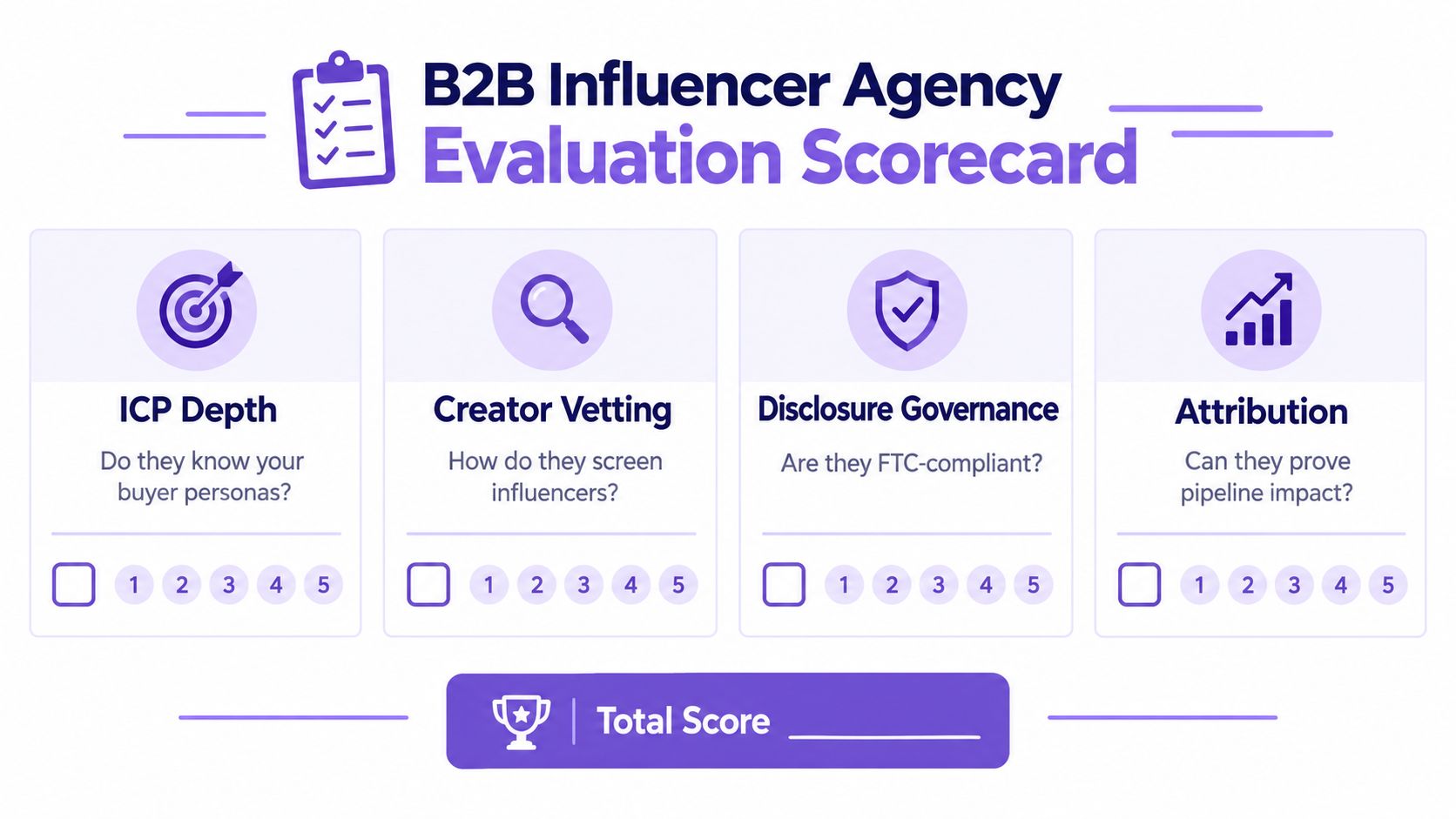
Put each agency through the same scorecard. Rate its answer to each question on a one-to-five scale, where a low rating means the response is vague or unsupported and a high rating means the agency can show its method, owners, and examples of the work product.
Ask questions that expose the operating model
- ICP depth: How do you define audience fit, and can you show how you’d assess our buyer roles and target accounts?
- Creator vetting: How do you validate expertise, engagement quality, commercial fit, and conflicts of interest?
- Disclosure and claims: Who checks paid disclosures and technical claims, and how do you handle a correction or unfavorable opinion?
- Attribution: Which creator, content, and interaction fields will be tracked, and how will campaign activity connect to target accounts and opportunities?
- CRM ownership: Who configures the data handoff, owns the records, and can access the reporting after the engagement ends?
- Data and procurement: Can the agency explain its approach to privacy, security review, data residency, and retention in terms your procurement team can assess?
Look for evidence rather than polished answers. Ask to see a sample brief, a creator scorecard, a disclosure workflow, and a redacted reporting view. A vendor that can explain how it works should be able to describe the handoffs without hiding behind a proprietary process. For broader context on how event vendors describe their responsibilities, PSW Events’ guide for UK event planners offers a useful comparison point for assessing campaign execution partners.
Use your company’s ideal customer profile guide to make the audience-fit discussion concrete. Then ask the agency to apply your criteria rather than substituting a generic creator database.
Disqualify vendors that hoard the basics
Treat these as warning signs: the agency claims it owns creator relationships, refuses to share creator and audience data, can’t explain its tracking structure, or reports impressions without showing how engagement reaches the CRM. Be cautious when a vendor promises pipeline but won’t define the attribution model, the source-versus-influenced distinction, or the client’s role in sales follow-up.
A mature partner won’t promise that every creator interaction becomes revenue. It will show what can be tracked, explain what remains uncertain, and agree on how both teams will use the evidence to improve the program.
Measuring Influence as Pipeline, Not Vanity
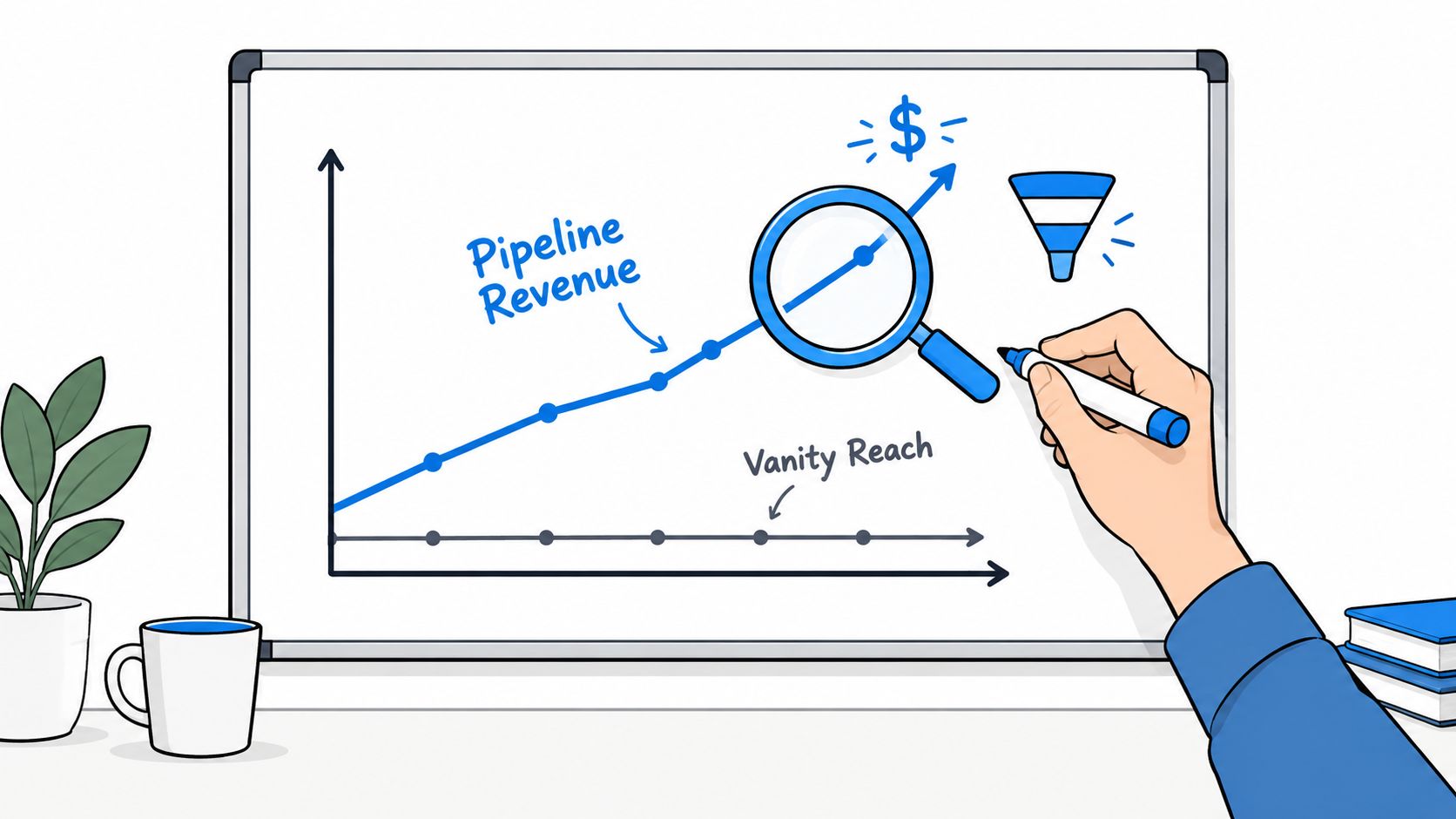
Set the measurement model before recruiting creators. Otherwise, the team will collect whatever is easiest to report, then struggle to connect activity to commercial outcomes. A B2B influencer program should measure how target accounts engage and progress, not only how often content appears in a feed.
Build a simple data chain that connects creator identity, content asset, audience interaction, target account, CRM contact, opportunity, and revenue. Use persistent creator and content IDs, UTM parameters, referral URLs, event-registration sources, and engagement timestamps. Add an opportunity-level field to record whether a creator influenced the buying process, with clear criteria for when sales or marketing can apply it.
Report the path, not a magic number
Track influenced-account coverage, engagement from target accounts, return visits, high-intent page activity, qualified meetings, opportunity creation, progression, and closed-won revenue. Compare engaged target accounts with a reasonable non-engaged group where possible, and review differences in progression and outcomes without claiming the creator caused every difference.
Keep sourced pipeline separate from influenced pipeline. Sourced means the creator activity generated the opportunity under your agreed definition. Influenced means the activity played a documented role in an opportunity that may have had other sources and touches. That distinction keeps reporting credible.
Measurement coverage still lags behind the metrics most programs track. One industry benchmark reports that 33% tracked revenue attribution and 25% tracked influenced pipeline, alongside more frequent tracking of engagement, ROI, and reach or views (MediaPost’s coverage of influencer measurement). The operational opportunity is to connect marketing evidence with account records and sales follow-up, rather than pretend that an impression is a conversion.
Make the handoff observable
An influencer interaction matters commercially when the right person can take an appropriate next step. That could be a sales follow-up, a scheduled meeting, or a useful conversation prompted by a high-intent visit. The method should fit your buying process and privacy rules. For a broader view of how influencer activity can sit inside a demand program, use this B2B demand generation guide as a planning reference.
Give your agency a reporting model that shows account engagement, content touches, CRM associations, and opportunity outcomes together. If the evidence stops at reach, don’t call the program pipeline-driven.
Captiwate helps B2B teams turn high-intent website visits into live sales conversations through in-browser video, AI chat, visitor identification, and CRM-connected meeting workflows. If your influencer program can bring qualified buyers to your site, visit Captiwate to see how to route that interest into a timely conversation.